
Two Ways of Seeing Morocco: Landscape Photography in Colour and Black & White
Landscape photography across Marrakesh, the High Atlas Mountains and the Sahara Desert.
Marrakesh, Morocco, lies just a three-hour flight from London. This is how close I am to a true North African adventure. Here, I will describe some of the photography I have discovered such a short distance from home. For photographers, Morocco offers an extraordinary range of landscapes. Sometimes, it feels as if you have been dropped onto another planet, as you will soon discover.
I am about to describe three great locations to photograph in Morocco and explain how I approached each one. These locations are:
The High Atlas Mountains: a towering, sometimes snow-capped range
The Sahara Desert: an almost unearthly world rising from the African plains below the Atlas Mountains
Marrakesh City: the incredible staging point and base for all these adventures
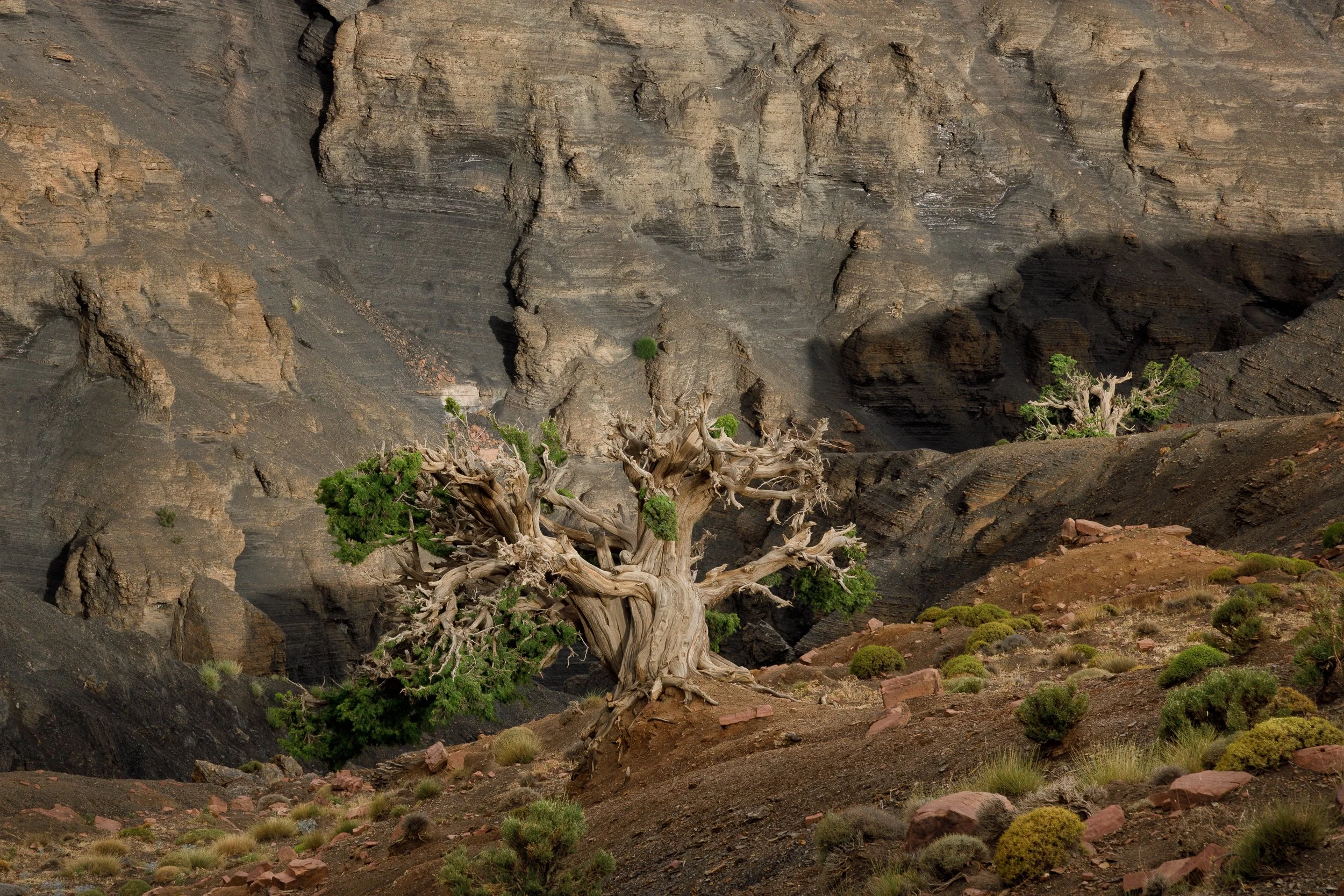
The Edge of Existence , High Atlas Mountains
Let’s start here.
Marrakesh
For photographers, Marrakesh is often the starting point for Morocco landscape photography and not just as a city in its own right, but as a gateway to the mountains and desert beyond.
For your average Westerner, Marrakesh is a crazy, unhinged place, so far removed from the organised worlds we are used to. Your senses are bombarded here in the city centre.
Entering the souks (street markets) is like stepping into a Jackson Pollock painting. Light filters through slatted roofs in thin, dramatic beams, catching suspended dust and illuminating stacks of brassware, leatherwork, carved cedar, and piles of saffron and cumin. Trinkets and clothing of every description are crammed into tiny streets just a few feet wide. Sometimes, the throng is so tight it can take ten minutes to go a few hundred yards.
Motorbikes career towards you, weaving in and out of the pedestrians. These bikes sometimes have whole families clinging to them. Amazingly, no one ever seems to get run over. Just as well, as there is no room for an ambulance or any other vehicle for that matter, save the odd cart and donkey. I did see one emergency paramedic—this involved pushing through the crowds with a stretcher/cart and, rather than a siren, yelling the alarm at the top of his voice.
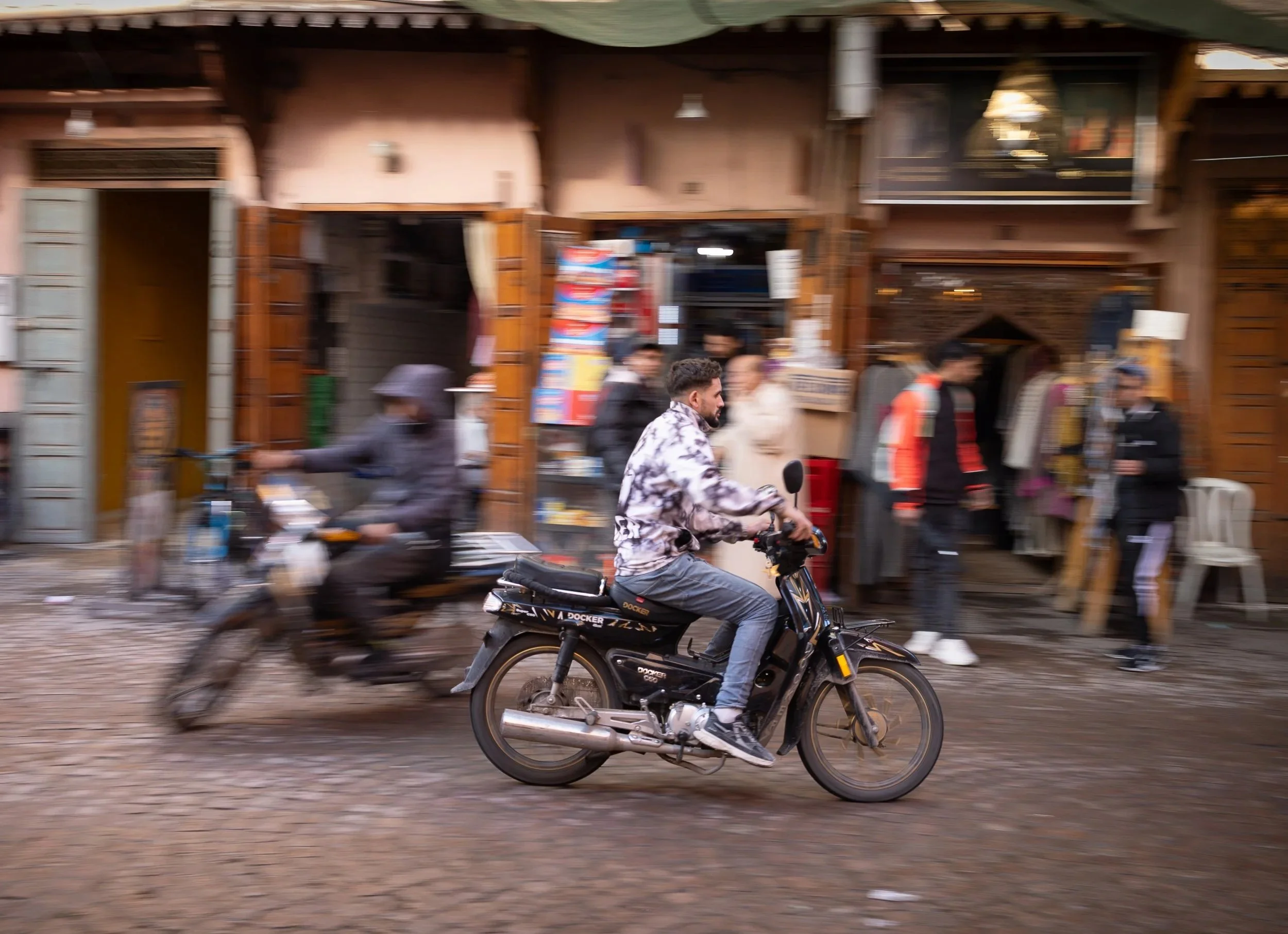
Crazy street traffic Marrakesh
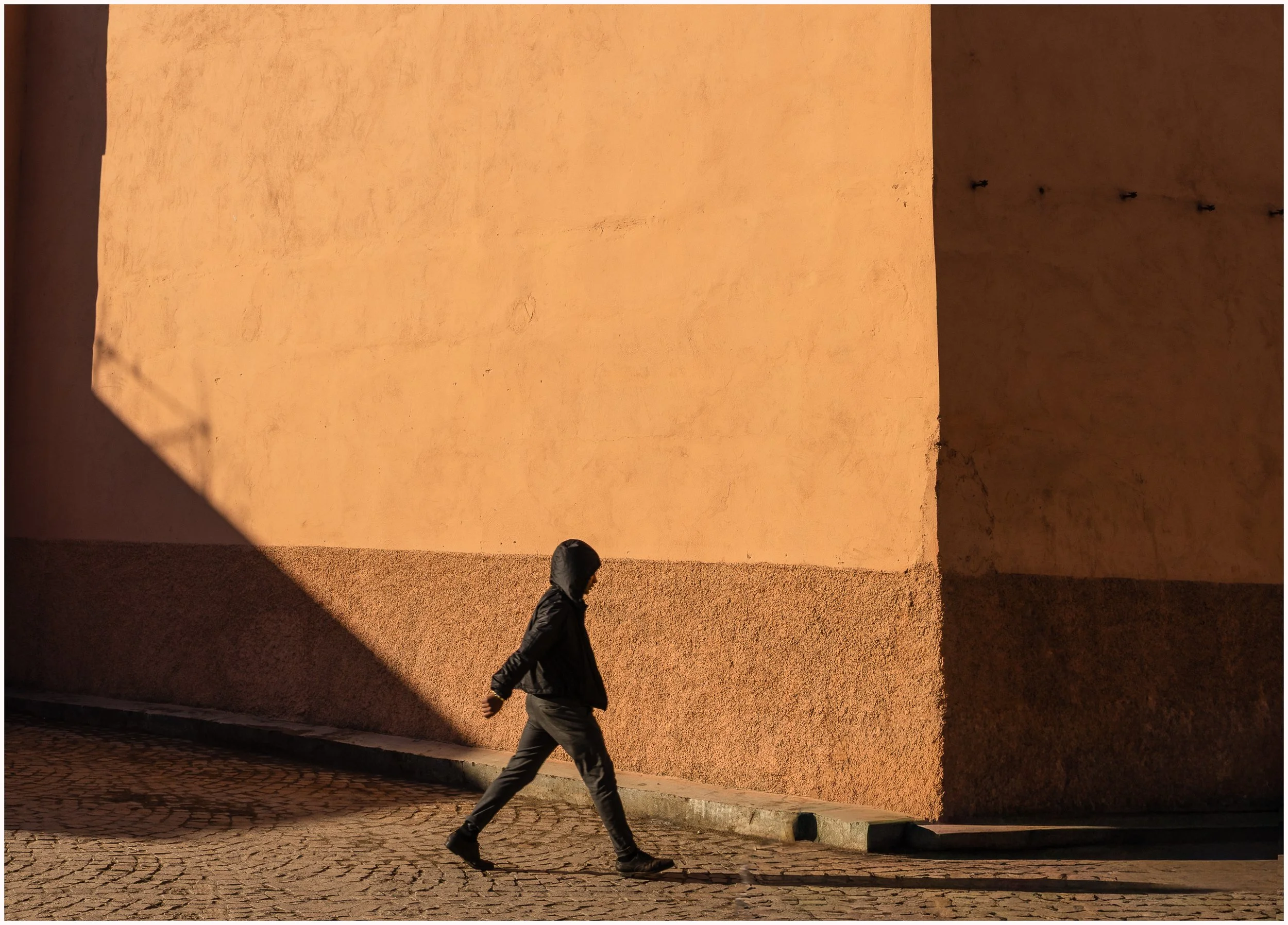
Evening Shadows Marrakesh
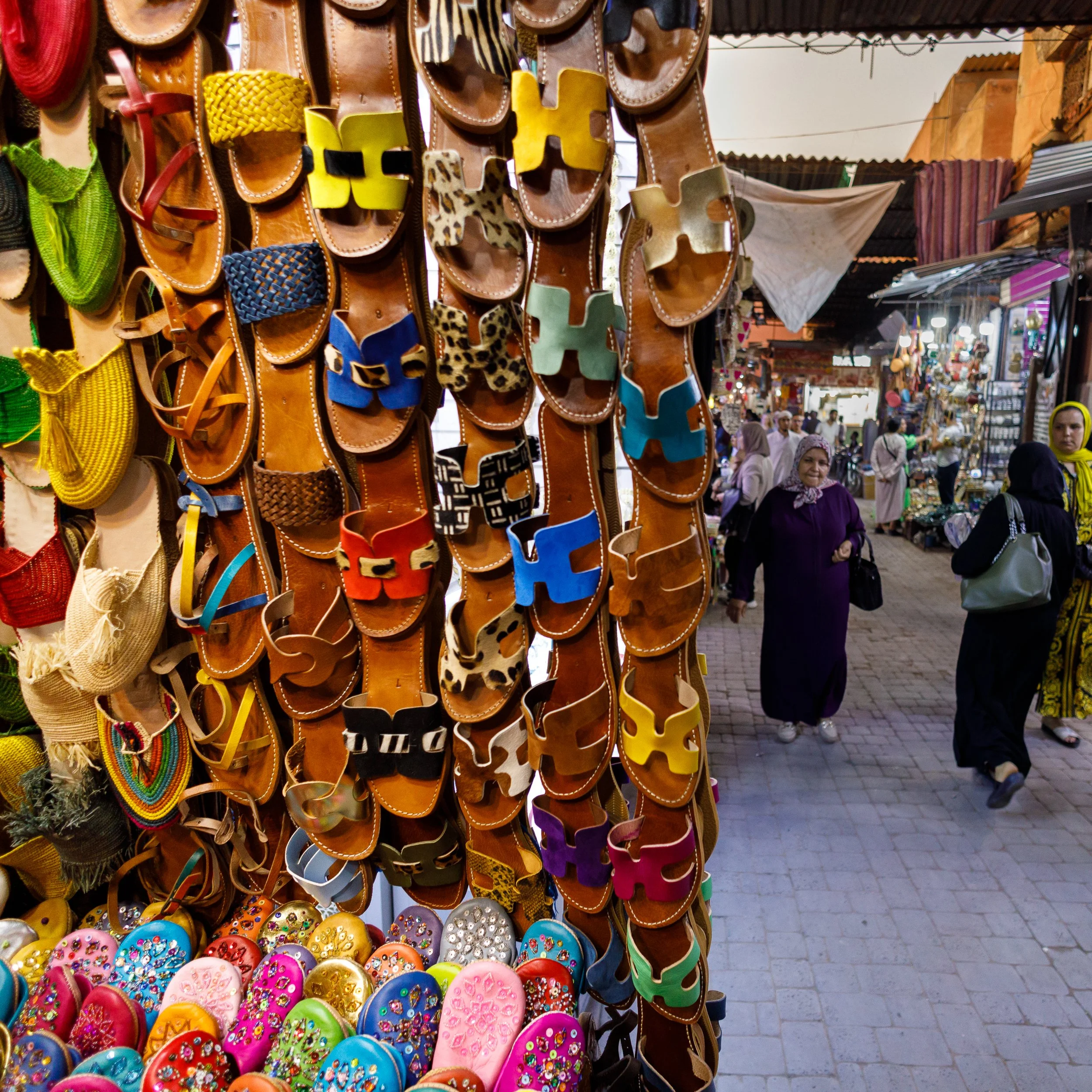
Souk market, Marrakesh
For a photographer accustomed to minimalism or Western storefront uniformity, the souks offer a sensory challenge. There is no single subject; everything competes to be the subject. Fix your sight on something and it is gone in the bustle a few seconds later.
For this type of photography, I resort to my "wait and watch" technique. Find a good junction or location, set the camera for the shot and pre-focus. Then you can stand quietly within this chaos and pick off your subjects one by one.
My understanding is that there are no legal restrictions for street photography; however, there is a balance to be drawn with the culture. The ladies do not like to be photographed, so my advice is to avoid doing so. There is plenty of material in any event, so you won’t be disappointed.
Keep your wits about you as it is really, really busy, but I never felt endangered. Harassed to buy a trinket I didn’t want, maybe, but through the bustle and chaos there is order and discipline within this community. Once chatting to strangers, they are polite, good-humoured, and friendly. Although, at one point, I did have someone screaming “Attention! Attention! Monsieur!”—just as I was about to stand on his cobra snake. I kid you not!
Colour or Black and White?
Here, I do not think it matters. It is all about speed and movement. My idea for shooting in Marrakesh was to try and separate my chosen subject using either the harsh lighting to frame the subject or to let the speed of the street isolate a subject. Crazy motorbikes, cyclists, pedestrians, carts, and donkeys passing through these streets can be panned at low shutter speeds such as 1/30th of a second, and bingo—the subject pops against the blurred colours of the city’s streets.
It was interesting that the images in the Marrakesh Photographers gallery were predominantly black and white. I think this makes sense when dealing with such contrasting, harsh light in a vibrant city that tries to distract your eye with every colour imaginable in such a small space.
The essence of standout street photography is often simplicity. In this city, black and white may be a great way to achieve this. But similarly, you cannot ignore Marrakesh’s riot of colour.
High Atlas Mountains
For many photographers, the High Atlas represents one of the most compelling areas for Morocco’s landscape photography, combining scale, texture, human presence, and extreme light.
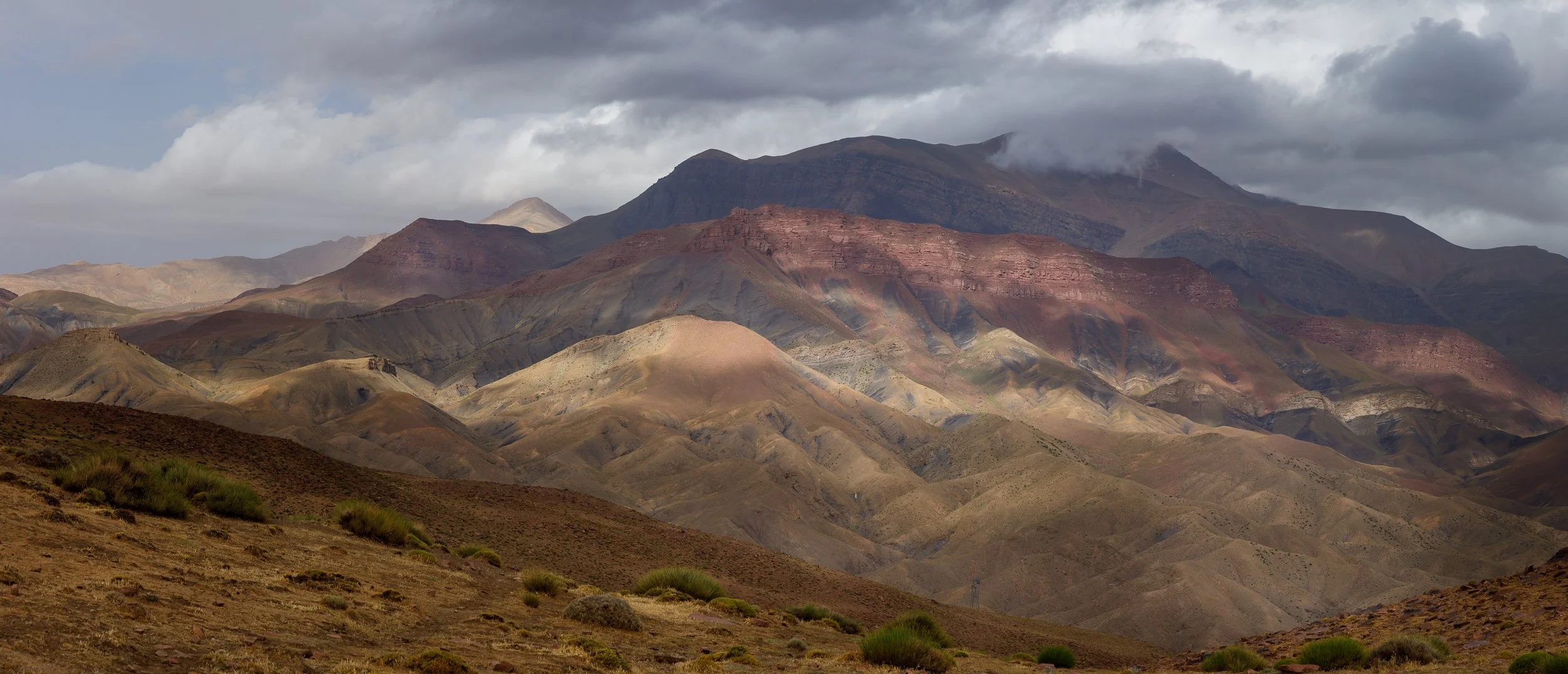
High Atlas Mountains, Morroco
On this occasion, we made a five-hour transfer with our driver from Marrakesh into the heart of the Atlas Mountains. The shift is gradual but unmistakable, with palm-lined valleys giving way to dry riverbeds, fortified villages, and vast slopes of iron-rich rock. The landscape becomes increasingly austere, carved by erosion and light rather than vegetation, with colours ranging from deep rust and ochre to pale limestone greys.
The plan was a ten-day trek deep into the mountains. These are not hills to be underestimated. The High Atlas is a place of extremes, where intense daytime heat can quickly give way to bitter cold once the sun drops behind the ridges. Dying of thirst or freezing to death are very real possibilities if you misjudge distance, weather, or terrain. Much of my travel is normally done independently, but for the more remote regions of Morocco, a guide was essential.
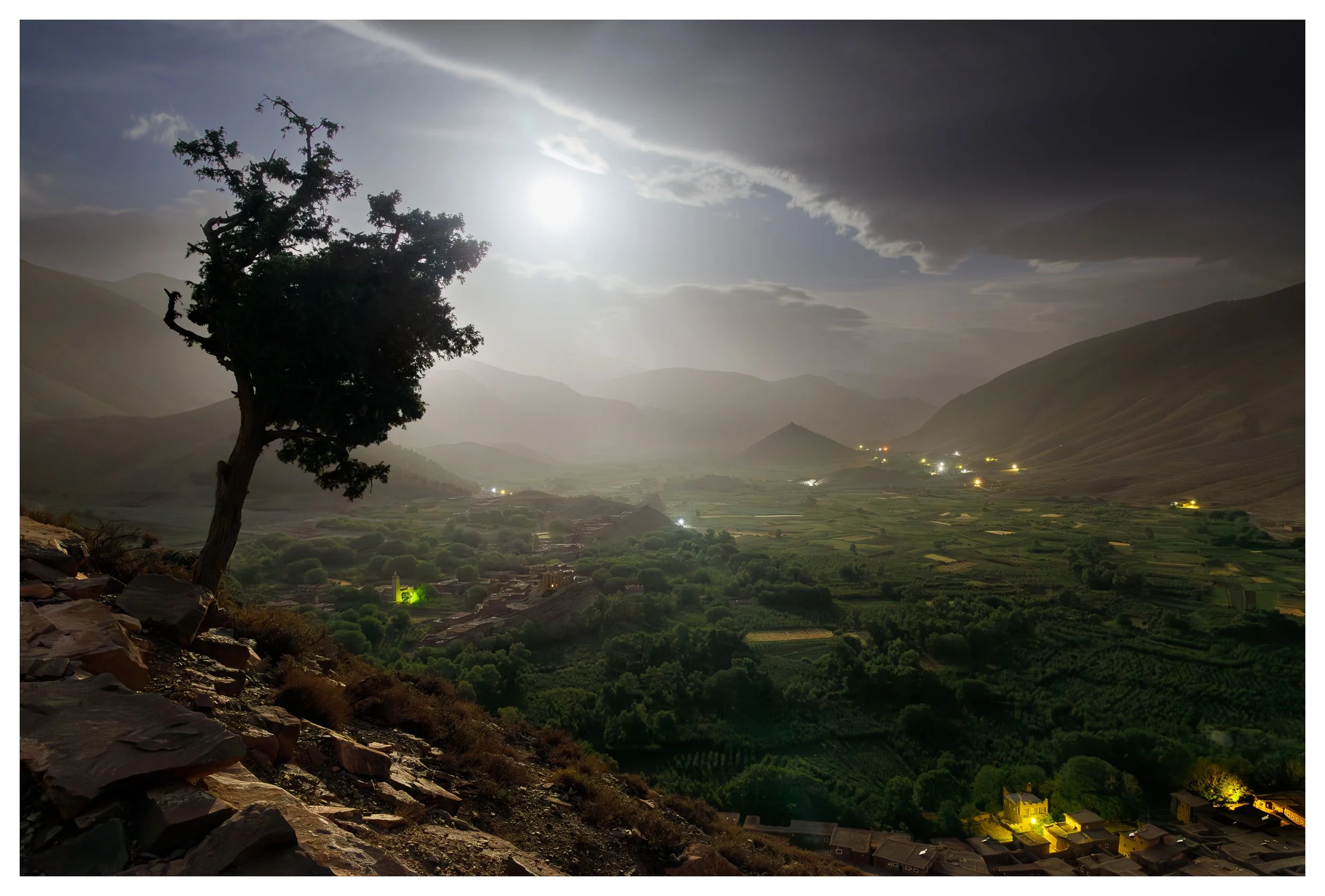
Moon Setting over Ait Bouguemez Valley. The start of our 10 day trek
The summit we aimed to climb lay five days’ walk from our starting point. This was Mount M’Goun, rising to 4,071 metres. The journey towards it passes through wide plateaus, narrow gorges, and high-altitude passes where villages appear to grow directly out of the rock. Life here feels shaped by the land rather than imposed upon it.
Much of this region is home to Amazigh (Berber) communities, some living permanently in stone-built villages, others moving seasonally through the mountains with their animals. Along the route, we passed small settlements, high summer pastures, and temporary camps where nomadic families still follow patterns dictated by weather, grazing, and altitude. Their presence feels quietly integrated into the landscape, with their paths worn into the rock, terraces held in place by hand-built walls, and irrigation channels that have existed for generations. It is a way of life that appears fragile, yet remarkably resilient.
We arranged guides and pack mules on arrival in Ait Bouguemez, often referred to as the “Happy Valley.” Despite the name, this is a working landscape of scattered terraced fields, cultivated valley floors, and stone homes that mirror the colour of the surrounding mountains. Time feels stretched here, and daily life remains closely tied to season, altitude, and light.
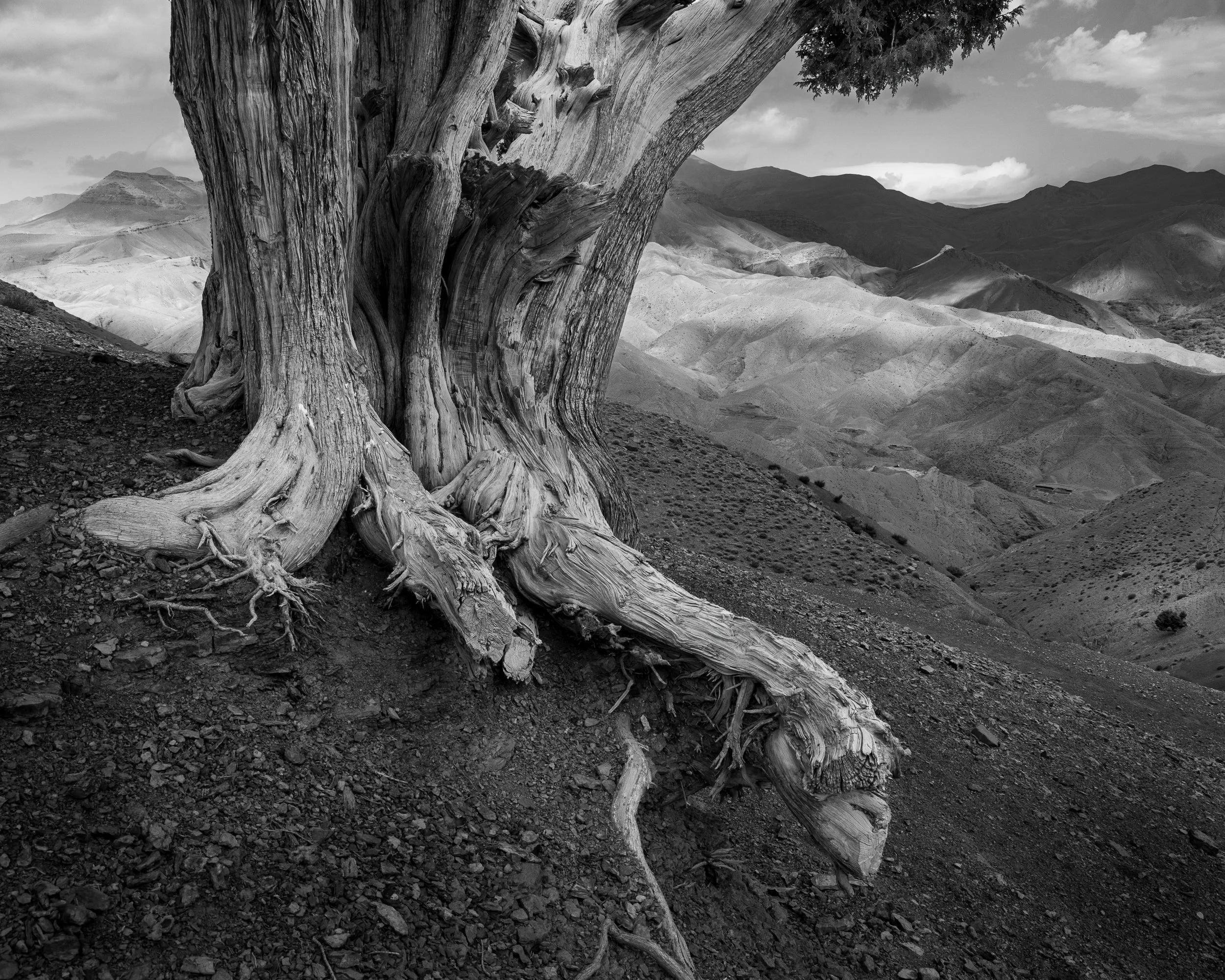
Juniper Trees on the slopes
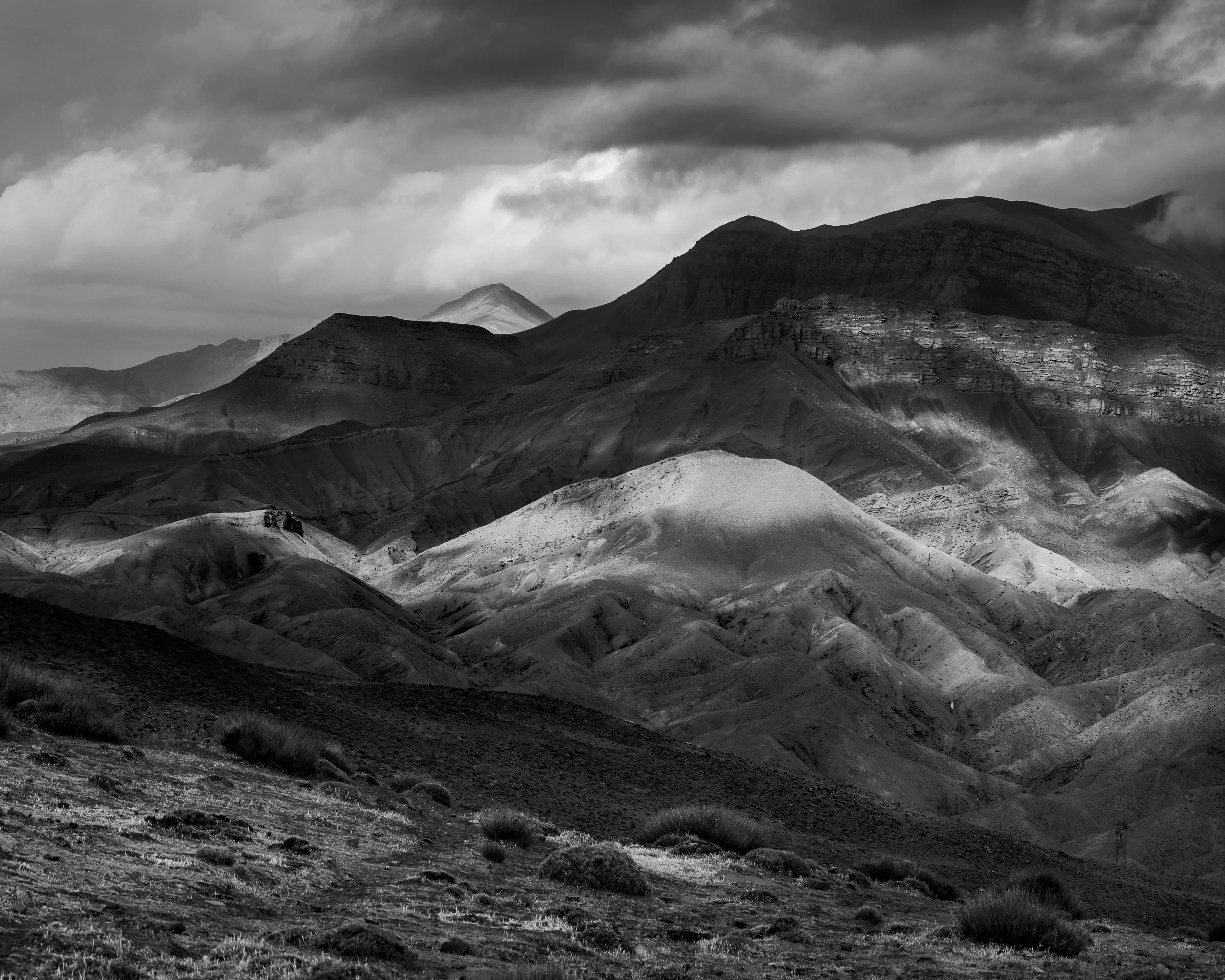
Awesome tones in the mountains
This was organised through YAK TRAVEL.CO.UK, a UK-based adventure travel company with experience in remote logistics and a deliberately low-key approach to travel in less accessible regions. Among adventure travellers, it is known for working closely with local guides and favouring smaller, less commercialised journeys. The people it tends to attract are already comfortable with physically demanding travel and are more interested in time, place, and cultural context than in packaged experiences.
Photographically, the environment encouraged simplicity. For the entire trek, I carried just a Canon EOS R, paired with the Canon RF 24–105mm f/4L for most images, and the Canon RF 16mm f/2.8 for the occasional wider view. A small travel tripod completed the kit. This setup is always a compromise, but one that removes distraction and clutter. Then I can allow my attention to remain on light, form, and the quiet relationship between people and landscape.
So, let’s get on with the mountain photography:
Why Morocco’s Red Desert and Mountains Look Exceptional in Black and White
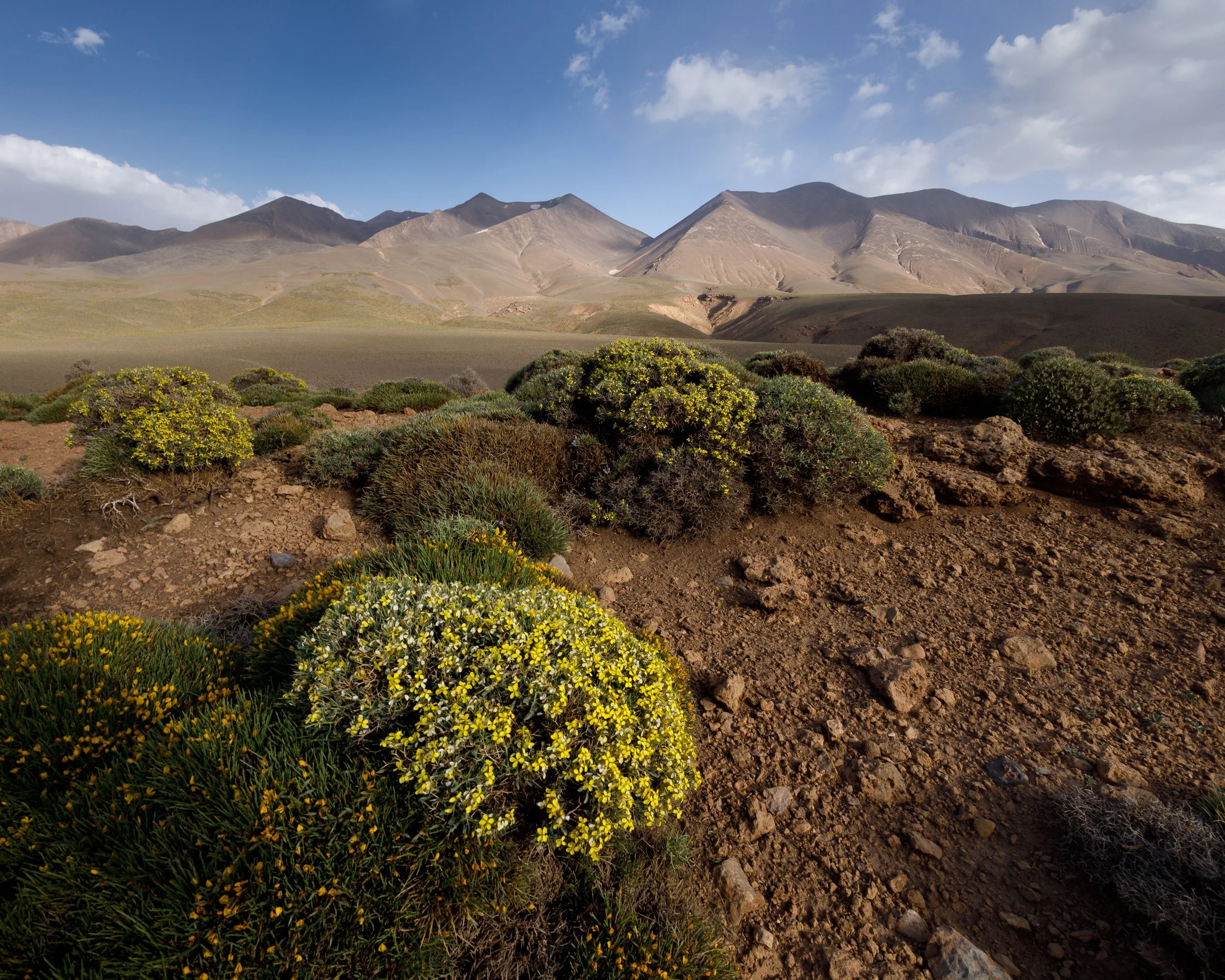
Mount M’Goun in Colour
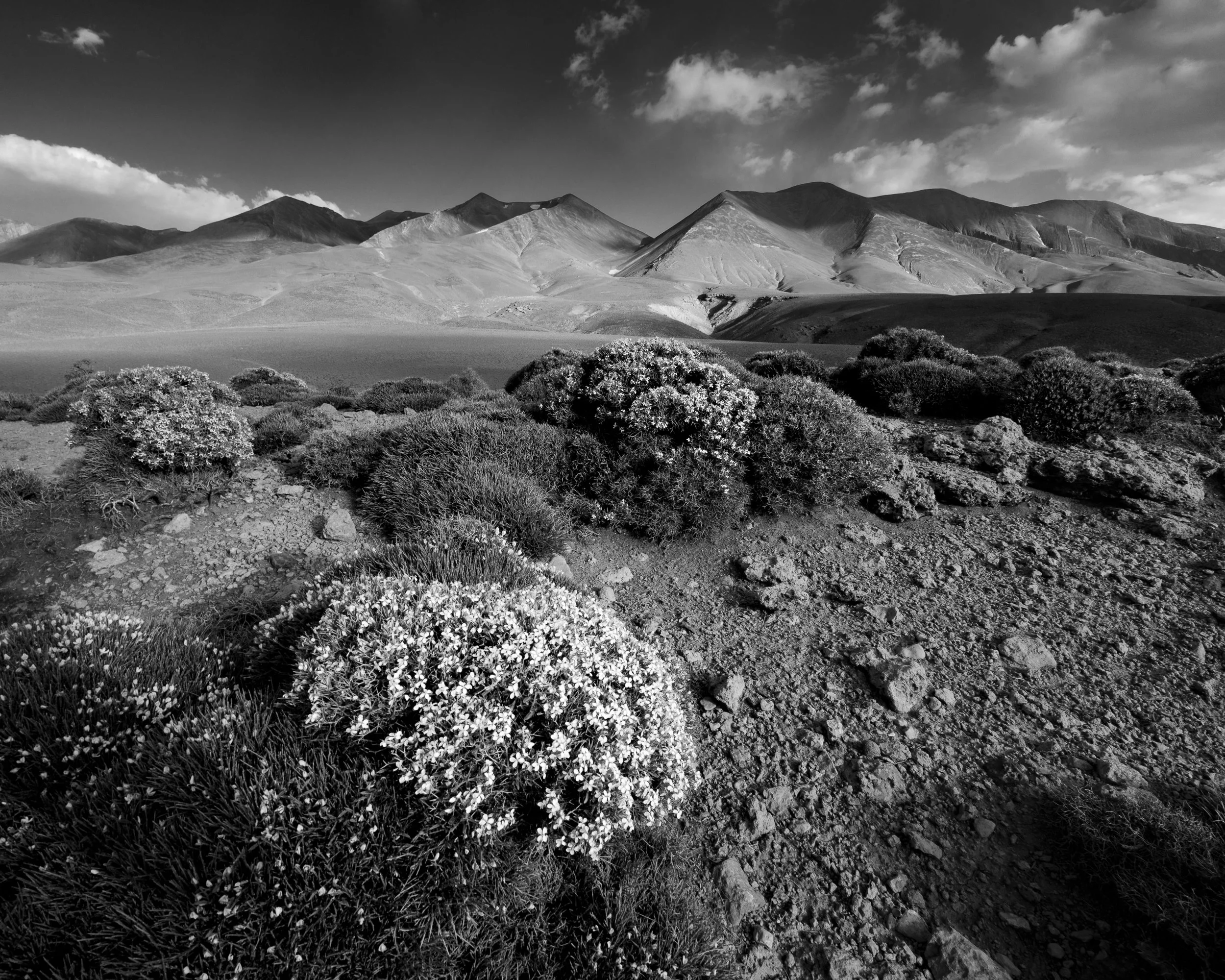
Mount M’Goun in B&W
Morocco’s red and ochre landscapes convert extremely well to black and white because of several factors that enhance tonal range, contrast, and texture.
High tonal separation:
Although the landscape appears mostly red, those red tones contain a wide range of luminance values. In colour, these differences can look subtle, but in black and white they separate clearly into strong highlights, mid-tones, and shadows. This creates a wide dynamic range ideal for black and white photography.
Strong directional light and crisp shadows:
Desert regions often have intense sunlight, low humidity, and minimal atmospheric diffusion. This produces deep shadows and bright highlights, giving natural contrast and well-defined shapes when converted to black and white.
Rich geological texture:
The landscape includes layered rock, eroded strata, cracked clay, gravel fields, and dune ripples. These surfaces catch light in different ways. In black and white, this creates stronger definition, depth, and a sculptural quality.
Simplicity of colour enhances form:
Because much of the landscape is within similar red and ochre tones, the colour information is simple. When converted to black and white, the viewer’s attention shifts to form, shape, and composition rather than colour differences.
Favourable behaviour of red and blue channels:
Red tones tend to convert well because they can be brightened during black and white conversion to bring out texture. Deep blue skies can be darkened to increase drama. Morocco’s combination of red terrain and blue sky is ideal for striking black and white images.
I shoot in colour rather than change my viewfinder to B&W. I seem to be able to mentally convert into black and white mode in my mind. I often quickly assess what a colour will look like in B&W and change the compositions to make this work. This ability comes with years of experience. Others with less experience will benefit from changing the viewfinder to Monochrome in live view.
The Sahara Desert
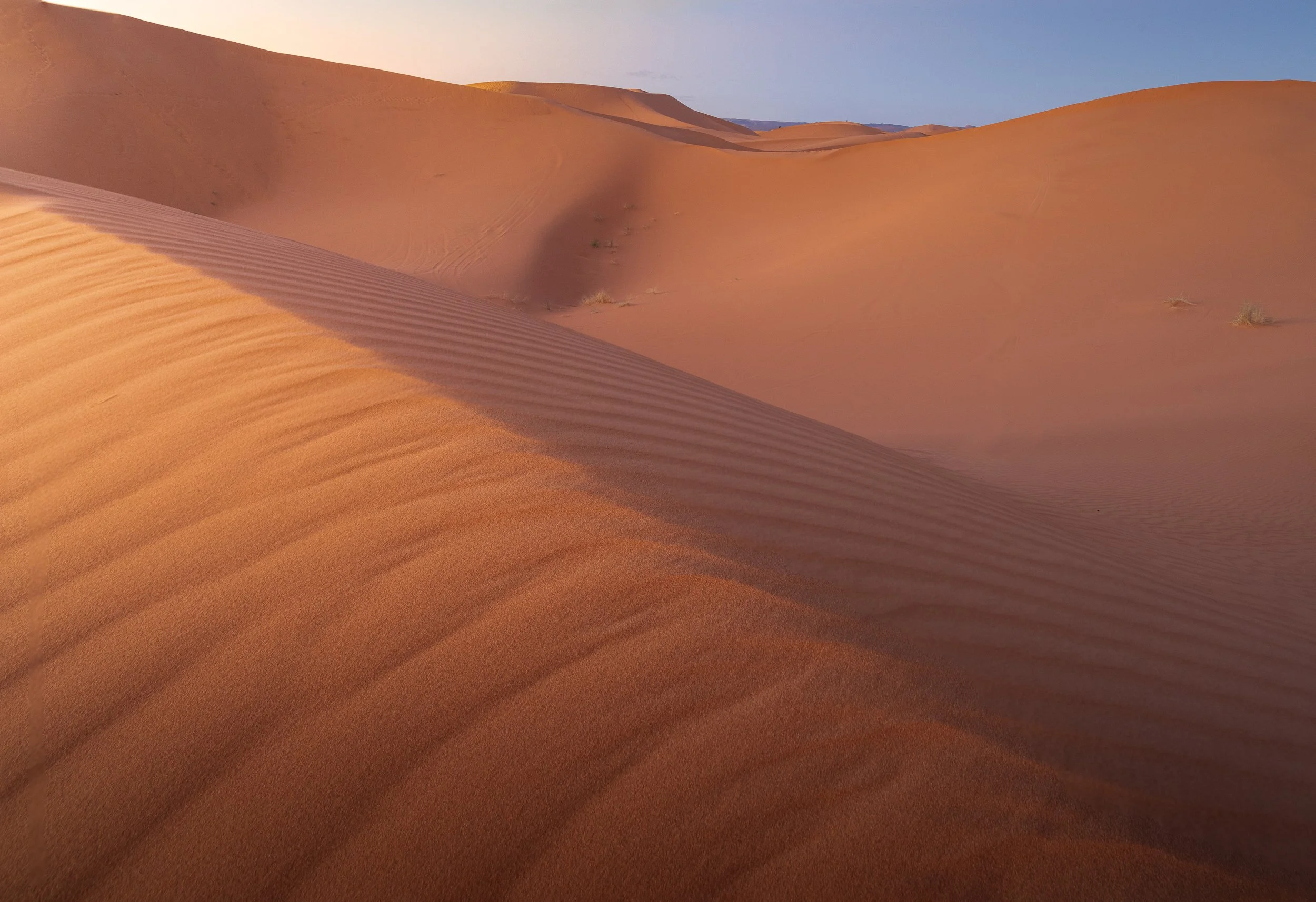
Sahara Sand Dunes, Erg Chebbi
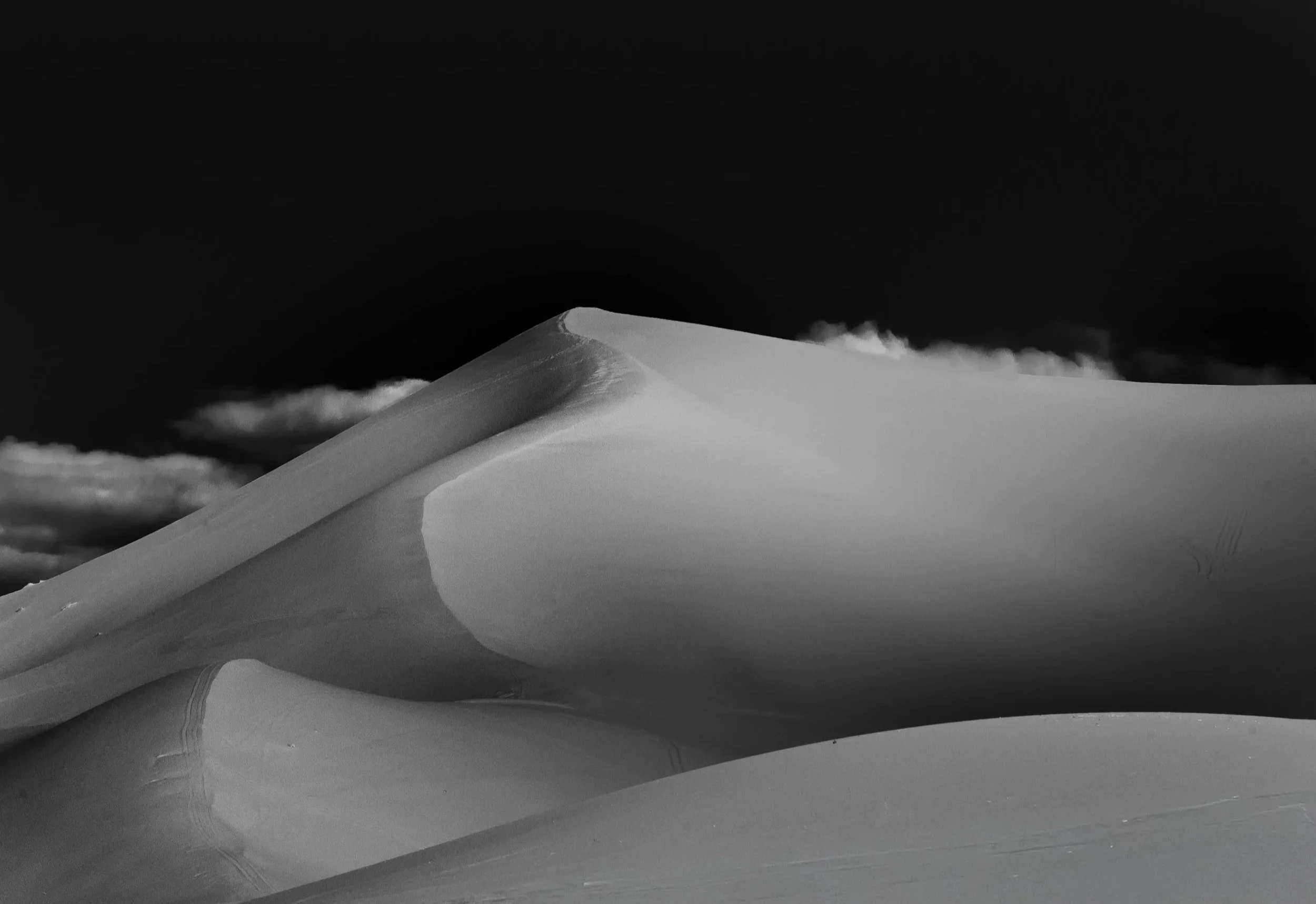
Sahara Sand Dunes
This Christmas, we decided to travel as a family to Morocco. What a surprise to find a white Christmas in North Africa rather than back in the UK. My photography was a bit limited, as this was a family trip and not dedicated to photography alone. However, there were opportunities, especially as we moved into the desert. I have not really posted any images from the snowy mountain passes here, as that was really just part of the road trip. However, once down in the desert, the mountains glistening with snow-capped peaks contrasting against the desert scenes below really added a touch of class to them.
This trip involved a lot of driving. This entailed two days of seven hours each just to get into the desert at Erg Chebbi. We had a great driver, Abdulrahim, whom we hired through YAK Travel.
The journey requires driving south out of Marrakesh and high over the Atlas Mountains. This road has been termed one of the most dangerous in the world by a recent BBC series. You could see why. The road had only just opened due to the really heavy snow a few days before. The journey through the passes was interspersed with the odd overturned vehicle and massive boulders that had cascaded onto the road from higher cliff faces towering above. (See video.)
Erg Chebbi
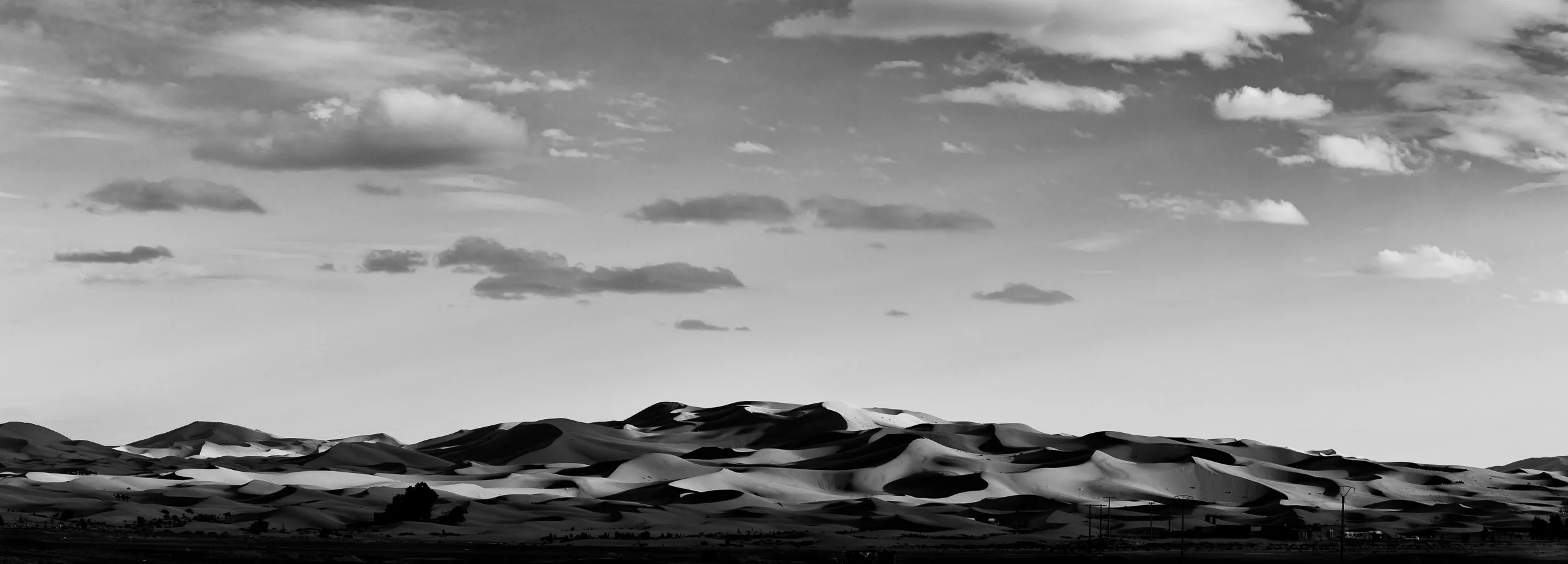
Approach to the Sahara Desert Dunes
The Sahara represents the most stripped-back expression of Moroccan landscape photography. It becomes possible to simplify images to just a few lines and textures. Less is often more in landscape photography.
The approach to Erg Chebbi begins long before the dunes appear. The snow-capped Atlas Mountains are now fast receding behind us. As we cross the wide Sahara plain, the landscape feels almost empty at first glance. It is an expanse of hard-packed earth, scattered stones, and low scrub stretching to a distant haze. But as you travel deeper, the plain reveals small signs of life. Lone acacia trees stand spaced far apart, their canopies flattened by years of desert winds. Beneath them, you occasionally find nomad families resting in the shade with their goats or camels, the outlines of their temporary camps blending almost seamlessly into the sand-coloured earth. There are the odd puffs of clouds drifting overhead, breaking up this deep blue sky.
Here, the desert hides its resources. Beneath the surface lie shallow aquifers, tapped by wells and khettaras that have supported nomadic travel for generations. The knowledge of these hidden water sources shapes the routes of both camels and people, and it’s often near these precious points that you encounter small clusters of life. Grazing animals, a tethered camel, or the silhouette of a nomadic herder crossing the plain with their animals leading the way.
As the road carries you further east, the dunes of Erg Chebbi begin to rise on the horizon. At first, they appear almost like a heat mirage, like thin waves of gold against the sky. But as the distance closes, their true scale emerges. The dunes rise sharply from the flat plain, forming a wall of sand that rolls and curves for kilometres, glowing deep orange in the afternoon light. Even from far away, the shape of the dunes feels sculptural, their crests cut sharply by the wind, their slopes sweeping down into soft, unbroken curves. This is a land I had only previously seen and imagined in Hollywood sci-fi movies. No wonder the previous large city we passed through had a massive international film studio. It seems I was now really on another planet. Everyone was in awe, even Abdulrahim.
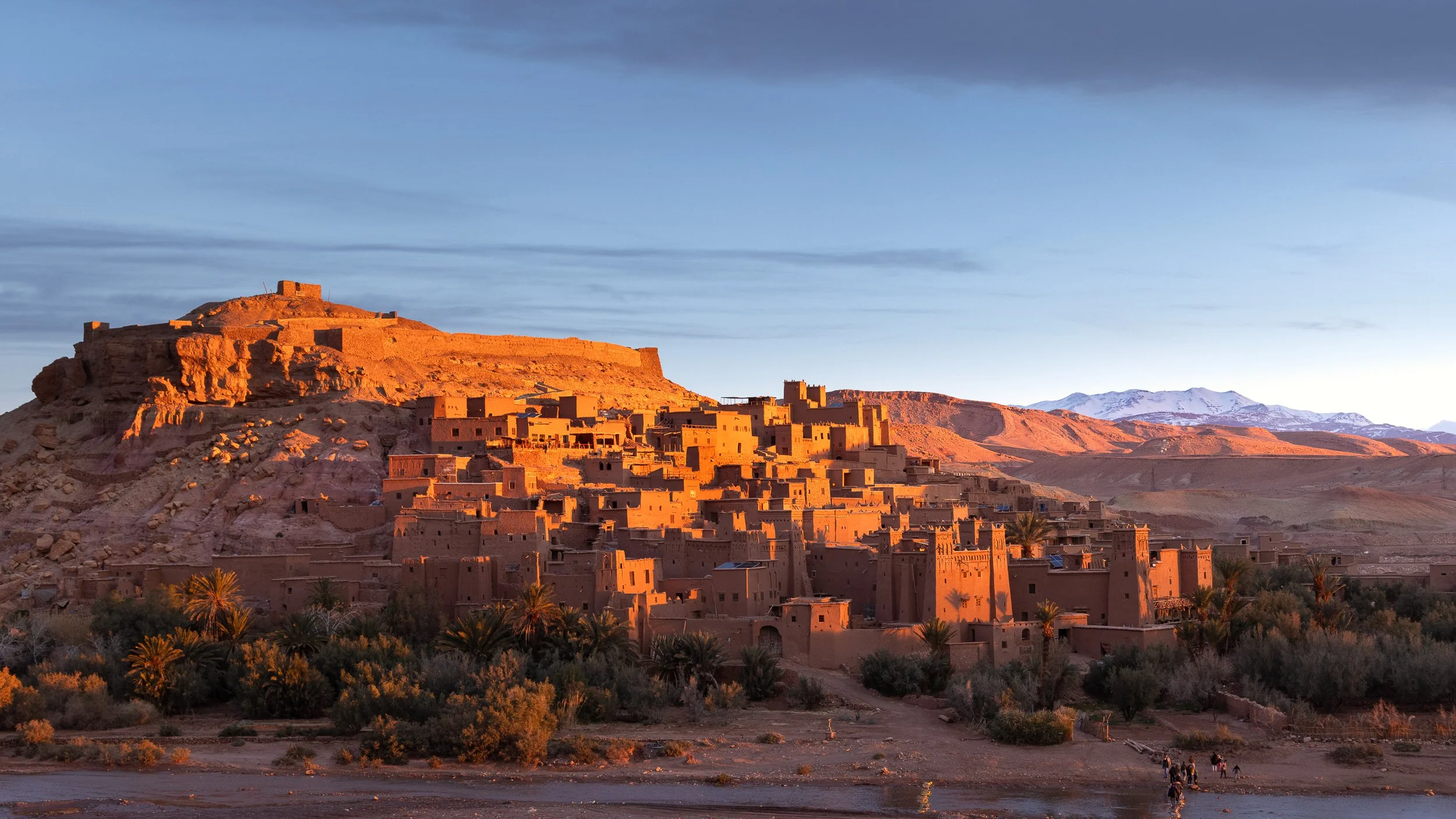
Sunrise over The Yellow City of Yunkai in Game of Thrones
Along the route lies Aït Ben Haddou, a fortified village built from the same red earth as the surrounding landscape. The ksar has been used repeatedly as a filming location, including as the ‘Yellow City’ of Yunkai in Game of Thrones. Seeing it in person, it’s easy to understand why this part of Morocco has become one of the most recognisable shooting locations for Game of Thrones, with architecture and terrain that feel both ancient and otherworldly.
Reaching the edge of the dunes, the character of the journey changes. The soundscape softens, the horizon narrows, and the stillness deepens. Here, at a small desert outpost, the camels wait, quiet, steady, and accustomed to the rhythm of travellers arriving at this hour. The light begins to shift towards the golden hour, and the sand underfoot cools slightly, holding the warmth of the day but losing its harsh glare. We need to rush at this point to get moving into the sunset for the optimum experience.
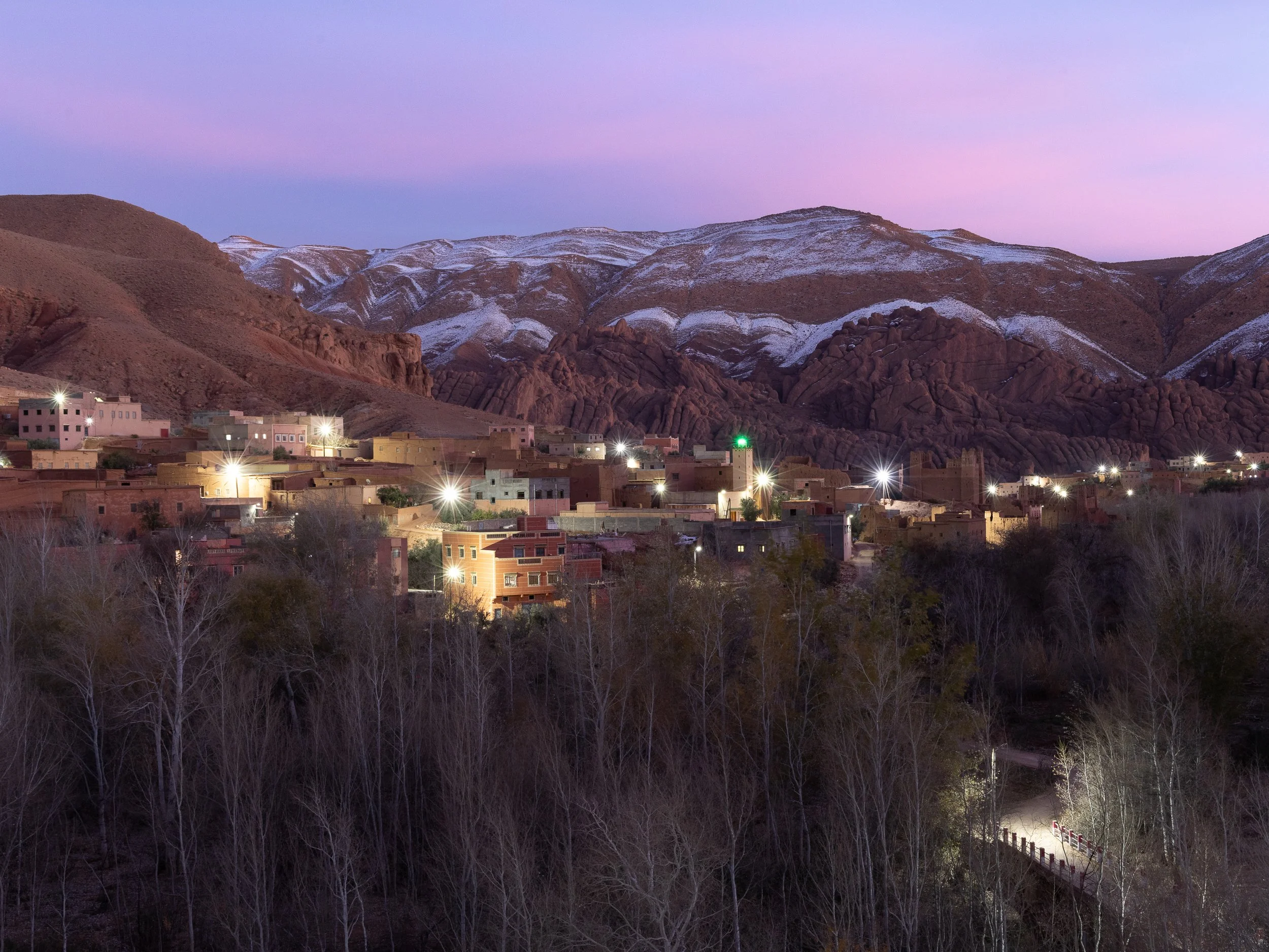
Snow touches the villages
Mounting a camel at sunset is a ritual in itself: the animal rising in two lurching stages, the saddle settling, the reins tightening, and then the slow, deliberate pace as the caravan begins to move. (This, I am afraid, if truth be told, is an extremely uncomfortable experience. The saddle is like wearing someone else’s walking boots!) As you climb into the dunes, the world behind you falls away. The desert becomes a sequence of ascending ridges, each hiding the next, each glowing richer as the sun drops lower. Shadows stretch across the sand, turning the ripples into sharp lines and the valleys into pools of deep shadow. There is silence, and our shadows appear against the orange dune backdrop—impossibly long shadows of camel legs stretching away from us, capped with the swaying bodies of the riders on our journey. These shadows appear like projections, and it is hard to associate them with ourselves.
From higher ground, the view opens into a sea of dunes, now shifting tones of gold, apricot, and amber. In the silence, only the soft thud of camel feet breaks the stillness, occasionally interrupted by an exclamation of discomfort from one of the riders. As the sun reaches the horizon, the dunes take on their most dramatic colours: the brightest edges catching the last light, the slopes turning almost red, and the distant sand fading into a muted blue-grey. It is here, among the high crests and falling shadows, that Erg Chebbi feels most alive. This is a desert that transforms minute by minute, and a place where colour and monochrome each reveal a different, equally compelling story. And this all starts again as the moon and the stars appear, revealing an even more surreal landscape.
Please feel free to comment on your experiences, ideas for locations and your view on B&W photography for landscapes generally in the comments box below.
For those still interested in travelling to these locations, please feel free to view my recent video covering the locations shown in this blog.